Leasing is an integral part of multifamily. Getting your property to full occupancy and keeping it consistently occupied can in some cases be a challenging task. Luckily, rentpace has figured out a proven system that solves this problem. At rentpace, we combine a data-driven lead generation with AI-powered software to get your property to full occupancy, and in this article, we’ll detail the whole process step-by-step.
Before we dive into this, I would like to provide a short explanation of some of the key conversion points to know, since we’ll be discussing these throughout this article.
- Lead to Application: This is the percentage of your leads that turn into applications.
- Application to Approved Application: The percentage of applications that are approved.
- Lead to Lease: The percentage of leads that turn into signed leases.
- Cost per lease: The marketing costs it takes to acquire a signed lease.
- Cost per lead: The marketing costs to acquire a lead.
The simple mathematics of leasing
Now that we’ve explained those terms, let’s run down how we identify whether performance is good.
The first step is to evaluate how many leads you’re getting, and at what cost, referred to as the cost per lease. The second step is to find your conversion rate for turning those leads into leases. To give you an example, if you get leads at an average of $20, and you convert 10% of those leads, you are securing a lease for $200. This number is the ‘cost per lease’ and It’s probably the most important metric in multifamily marketing and leasing.
In between that, there are some other data points to note, as described above, such as the percentage of leads that turn into applications, and which percentage of applications turn into approved applications.
Those metrics are in between is the ‘lead to lease’ number, and that number can often point to problems within the overall cycle. Sometimes, an abnormally low application to approved application ratio can point to a problem with the quality of the traffic you’re getting. On the other hand, a low lead to application ratio can point to problems within your sales process, and not being able to convert leads into applications at a standard rate, which could cost you unnecessarily higher marketing costs.
Although the main key performance indicator most operators and managers look at is ‘lead to lease’ since that’s what directly affects the bottom line, those metrics play a big role as well and are a direct contributor to your lead to lease.
What are good numbers?
Property conversion ratios and costs are different depending on a variety of factors, some of those factors include: Asset class, Location, Competition, Seasonality, and the methods you use to acquire leads. It’s hard to point to a rule-of-thumb number since it does vary based on those factors, although the typical lead-to-lease ratio is anywhere between 5-15%, with 5% being on the low end, and 15% being on the higher end.
There have been studies done to identify average benchmarks for these numbers
Study: https://blog.reachbyrentcafe.com/rental-lead-conversion-data/
How to measure lead traffic
If you’ve gotten this far, you’re probably waiting for the blueprint that we use for filling up your vacancies. We’re going to get into that in a bit, but before, some important context around how to measure your incoming lead traffic.
-
- Getting ‘quality’ leads at affordable costs
The quality of your leads plays a big role in a high lead-to-lease conversion rate. Regarding lead quality, that usually comes down to the source where the leads are coming from. In a national study from Yardi of lead-to-lease conversions across 1,533 property websites, PPC leads received a 15.44% lead-to-lease conversion rate. ILS sources, such as apartments.com and zillow came way under at 2.37%. Although that number is much lower, it’s important to note that lead quantity and cost per lead (CPL) also matter.
-
- Measuring quality with cost
Everyone loves high-quality leads, but at the same time, measuring how much those leads are costing is another metric we constantly monitor within our campaigns.
For example, if you’re getting 100 leads from ‘source A’ at an average of $5 per lead, and you get two leases from those 100 leads, that’s a cost-per-lease of $250.
Now on the flip side, you get 30 leads from ‘Source B’ at $35 per lead, and you get 4 leases from those 30 leads, that’s a cost-per-lease of $262.
If you do the math, source A had a conversion rate of 2%, and source B had a conversion rate of 13%. Although the conversion rate in source B is significantly higher, source A had a lower overall cost per lease. This is why measuring cost with quality is crucial, since lower quality leads, if significantly cheaper, can provide a higher overall ROI.
Our marketing process and the channels we target
At rentpace, we have used and experimented with many channels. Although performance of channels do differ by market, PPC, when done right, has typically provided our clients with the best ROI.
A study by Yardi showed that on average, PPC delivers a cost-per-lease at $588, where the average ILS cost per lease was $607.
Read more on the strategies we use to drive leases with PPC here: Input blog article here
Tips and tricks you can use to improve your multifamily PPC campaign:
The best marketing approach to take is one that covers many channels. This approach is referred to as a multichannel marketing approach, and when your property is marketed throughout all the popular sources, it brings down your overall CPL for every channel.
Online Reviews
Another important element you should keep a close eye on at all times – your reviews. According to Satisfact, 75% of renters check a property’s reviews before ever making contact. If your reviews are poor, you’re losing out on traffic, which has a direct effect on your lead costs.
Before spending money on marketing, your reviews should be as polished as can be. This is a direct support beam for your marketing efforts.
Some ideas to increase your positive reviews:
- Set up automation that requests new move-ins to publish a positive review a week after move-in
- Have a sign in the front office with a QR code linking to your review sites
- Ask your tenants directly. If your tenants are happy at your property, they’ll be happy to publish a nice review
- Make sure to respond to positive reviews, this helps the algorithm boost your listing
Social Media
Social media is another popular channel. The primary way we use this channel is to retarget website visitors. This doesn’t generate leads directly, but it does increasing your overall website conversion rates by keeping your property top of mind.
You can learn more about social media retargeting here.
Automated Lead Nurturing
Now that we’ve figured out how to acquire leads in quality and quantity, it’s time to turn those leads into tours and applications.
Let’s start with this simple rule – a lead is only as good as how you handle it. If your leads are answered quick, and followed up with constantly, you’ll have a much higher lead to application rate than if that were not the case. This part of the process is usually handled by on-site leasing agents, which can make results contingent on staffing, and employee performance.
Luckily, Rentpace has developed a solution to streamline this process through software that sends automated messages and follow ups based on indicators on where your leads stand in their journey.
This is our secret weapon to leasing. Anyone can find ways to generate leads, although converting those leads efficiently and consistently….. that’s been a harder puzzle to solve for multifamily owners and operators.
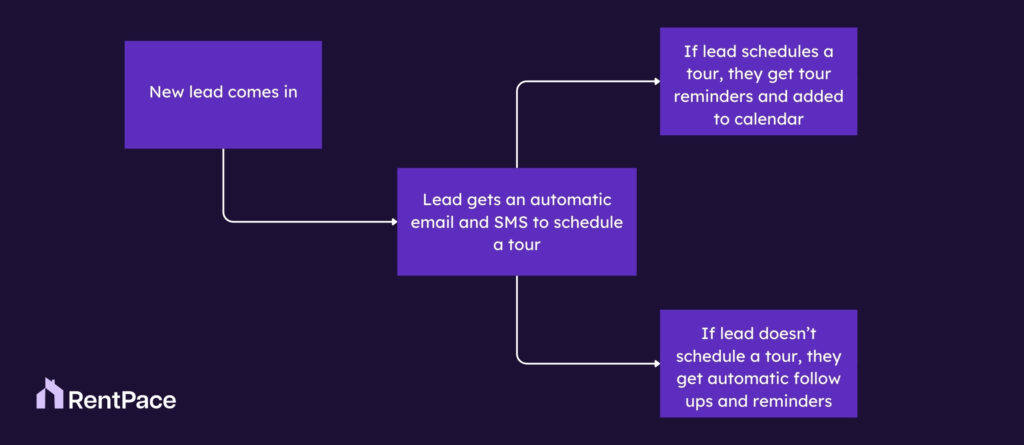
This has also shown to be a proven system when it comes to increasing show rates for tours, since it will also sent emails and text messages reminding prospects of their tour leading up to the scheduled time.
Conclusion:
There are many moving parts to leasing. To drive the most effective results, your goal should be to optimize each stage of the funnel and have a thorough understanding and measurement of your data.
At Rentpace, we’ve created a streamlined AI-powered system that uses this approach to get multifamily properties across the United States improve their leasing and occupancy. If you would like to see how we can implement this proven system for your property, feel free to contact us.